The Cells That Can Take Any Form or Function Are Called What?
Humans are made upwardly of trillions of cells — the bones unit of measurement of life on globe. In this article, we explicate some of the structures constitute in cells and draw a few of the many types of jail cell institute in our bodies.
Cells can be thought of equally tiny packages that contain infinitesimal factories, warehouses, transport systems, and ability plants. They function on their ain, creating their own free energy and self-replicating — the cell is the smallest unit of measurement of life that can replicate.
However, cells also communicate with each other and connect to create a solid, well stuck-together animal. Cells build tissues, which course organs; and organs piece of work together to go on the organism alive.
Robert Hook beginning discovered cells in 1665. He gave them their name considering they resembled the cella (Latin for "small rooms") where monks lived in monasteries.
Dissimilar prison cell types can look wildly different, and carry out very different roles within the body.
For case, a sperm cell resembles a tadpole, a female person egg prison cell is spherical, and nerve cells are essentially thin tubes.
Despite their differences, they often share certain structures; these are referred to as organelles (mini-organs). Beneath are some of the most important:
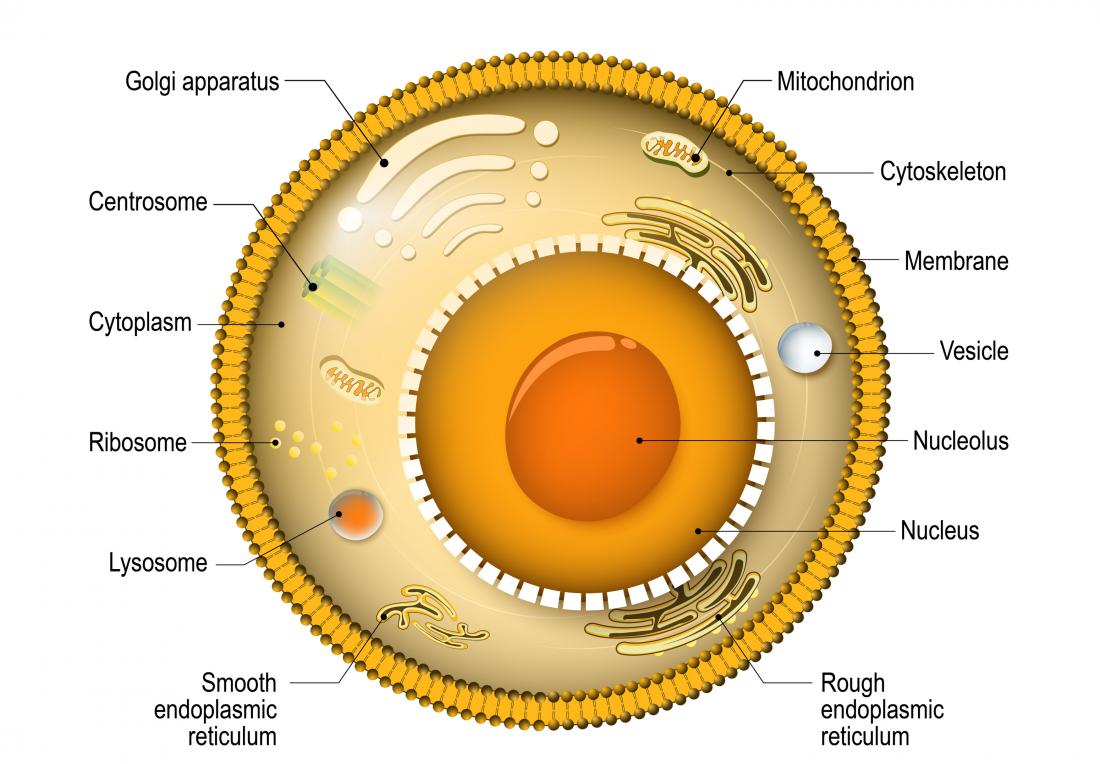
A simplified diagram of a human being cell.
Nucleus
The nucleus can be idea of equally the cell'southward headquarters. There is normally one nucleus per cell, but this is non always the case, skeletal muscle cells, for example, have two. The nucleus contains the majority of the cell's Deoxyribonucleic acid (a small amount is housed in the mitochondria, see below). The nucleus sends out messages to tell the jail cell to grow, divide, or die.
The nucleus is separated from the residue of the cell by a membrane called the nuclear envelope; nuclear pores inside the membrane allow through minor molecules and ions, while larger molecules need send proteins to assistance them through.
Plasma membrane
To ensure each cell remains split up from its neighbor, it is enveloped in a special membrane known as the plasma membrane. This membrane is predominantly made of phospholipids, which prevent water-based substances from entering the cell. The plasma membrane contains a range of receptors, which conduct out a number of tasks, including being:
- Gatekeepers: Some receptors allow sure molecules through and end others.
- Markers: These receptors act as name badges, informing the immune system that they are part of the organism and not a foreign invader.
- Communicators: Some receptors help the cell communicate with other cells and the environment.
- Fasteners: Some receptors help bind the cell to its neighbors.
Cytoplasm
The cytoplasm is the interior of the cell that surrounds the nucleus and is effectually 80 percent water; it includes the organelles and a jelly-like fluid called the cytosol. Many of the of import reactions that take place in the jail cell occur in the cytoplasm.
Lysosomes and peroxisomes
Both lysosomes and peroxisomes are substantially numberless of enzymes. Lysosomes contain enzymes that pause down large molecules, including old parts of the cells and foreign cloth. Peroxisomes contain enzymes that destroy toxic materials, including peroxide.
Cytoskeleton
The cytoskeleton can exist considered the scaffolding of the cell. It helps information technology maintain the correct shape. However, unlike regular scaffolding, the cytoskeleton is flexible; it plays a office in cell division and cell motion — the ability of some cells to motility, such equally sperm cells, for case.
The cytoskeleton also helps in jail cell signaling through its involvement in the uptake of textile from outside the cell (endocytosis) and is involved in moving materials around within the prison cell.
Endoplasmic reticulum
The endoplasmic reticulum (ER) processes molecules inside the cell and helps transport them to their concluding destinations. In particular, information technology synthesizes, folds, modifies, and transports proteins.
The ER is made up of elongated sacs, called cisternae, held together by the cytoskeleton. There are two types: rough ER and polish ER.
Golgi appliance
In one case molecules accept been processed by the ER, they travel to the Golgi appliance. The Golgi apparatus is sometimes considered the mail office of the cell, where items are packaged and labeled. Once materials leave, they may be used within the jail cell or taken exterior of the prison cell for use elsewhere.
Mitochondria
Often referred to every bit the powerhouse of the cell, mitochondria help turn energy from the nutrient that we eat into energy that the cell can use — adenosine triphosphate (ATP). However, mitochondria have a number of other jobs, including calcium storage and a role in cell death (apoptosis).
Ribosomes
In the nucleus, Deoxyribonucleic acid is transcribed into RNA (ribonucleic acrid), a molecule like to DNA, which carries the aforementioned message. Ribosomes read the RNA and translate it into poly peptide by sticking together amino acids in the order defined by the RNA.
Some ribosomes float freely in the cytoplasm; others are fastened to the ER.
Our body is constantly replacing cells. Cells demand to divide for a number of reasons, including the growth of an organism and to fill gaps left by dead and destroyed cells subsequently an injury, for instance.
There are two types of cell segmentation: Mitosis and meiosis.
Mitosis
Mitosis is how most of the cells in the trunk split up. The "parent" cell splits into two "daughter" cells.
Both daughter cells take the aforementioned chromosomes as each other and the parent. They are referred to as diploid because they have 2 complete copies of the chromosomes.
Meiosis
Meiosis creates sexual activity cells, such equally the male sperm and female egg cells. In meiosis, a small portion of each chromosome breaks off and sticks to some other chromosome; this is chosen genetic recombination.
This ways that each of the new cells has a unique set of genetic data. It is this procedure that allows genetic diversity to occur.
And then, in brief, mitosis helps us grow, and meiosis makes sure we are all unique.
When y'all consider the complexity of the human body, it is no surprise that there are hundreds of different types of cell. Beneath is a pocket-size selection of human cell types:
Stem cells
Stem cells are cells that are yet to choose what they are going to go. Some differentiate to get a certain cell type, and others divide to produce more stem cells. They are found in both the embryo and some adult tissues, such every bit bone marrow.
Bone cells
There are at to the lowest degree three primary types of os prison cell:
- Osteoclasts, which dissolve bone.
- Osteoblasts, which form new os.
- Osteocytes, which are surrounded by bone and help communicate with other bone cells.
Claret cells
There are three major types of blood cell:
- red blood cells, which carry oxygen around the torso
- white blood cells, which are part of the immune system
- platelets, which assistance claret clot to prevent claret loss after injury
Muscle cells
Likewise called myocytes, muscle cells are long, tubular cells. Muscle cells are important for a huge range of functions, including movement, support, and internal functions, such every bit peristalsis — the movement of food along the gut.
Sperm cells
These tadpole-shaped cells are the smallest in the human body.
They are motile, meaning that they tin motility. They achieve this movement by using their tail (flagellum), which is packed with free energy-giving mitochondria.
Sperm cells cannot divide; they only carry i copy of each chromosome (haploid), dissimilar the majority of cells, which comport two copies (diploid).
Female egg cell
Compared with the sperm cell, the female egg cell is a giant; it is the largest homo cell. The egg jail cell is as well haploid so that the Dna from the sperm and egg tin can combine to create a diploid cell.
Fat cells
Fat cells are as well called adipocytes and are the chief constituent in adipose tissue. They contain stored fats chosen triglycerides that tin can be used as energy when needed. Once the triglycerides are used upward, the fat cells shrink. Adipocytes also produce some hormones.
Nerve cells
Nerves cells are the advice system of the body. Also called neurons, they consist of two major parts — the cell body and nerve processes. The cardinal body contains the nucleus and other organelles, and the nerve processes (axons or dendrites) run like long fingers, conveying letters far and broad. Some of these axons tin can be over 1 meter long.
Cells are as fascinating as they are varied. In i sense they are democratic cities that function alone, producing their own energy and proteins; in another sense, they are function of the huge network of cells that creates tissues, organs, and us.
Source: https://www.medicalnewstoday.com/articles/320878
0 Response to "The Cells That Can Take Any Form or Function Are Called What?"
Post a Comment